

Listen to this article
Listen time 6 min 04 s
Show the transcript
Download this guide and checklist as a PDF
You are about to build a pool, an extension, a shed or a new fence on the Gold Coast, and someone has asked whether there is an easement in the way. Perhaps your conveyancer mentioned one in the contract. Perhaps you can see a sewer manhole in the backyard and wonder what it means for the slab.
The short answer is a current title search, which lists any registered easement. You can do the checks yourself online for about $100 in government search fees, though some documents take a few days to arrive. This guide shows the three checks in order, what each one proves, and the point where the records stop and a survey starts.
General information only, not legal advice. Fees and pages checked 10 November 2026.
Is there an easement on my property? The short answer
In Queensland an easement over a lot is created by registering an instrument of easement, so a registered easement sits on the title (Land Title Act 1994, section 82). Titles Queensland says a current title search shows the current owner and "other registered interests, including mortgages, easements, covenants, leases and caveats" (Titles Queensland, title searches).
An easement is a registered right for someone else to use part of your land for a set purpose: a neighbour's access, a drainage line, or a corridor for sewer, water, power or telecommunications. Your land is the "burdened" land. The neighbour's lot, or the authority that holds the easement, takes the benefit.
Key takeaways
- Queensland Globe is a free first look, but its lines are a map, not your legal boundary.
- The current title search is the record that lists registered easements.
- The plan of your lot may not show an easement created on another plan, so follow the plan and dealing numbers the title gives you.
- The records tell you an easement exists and how it is described. A survey shows where it falls against what you plan to build.
Step 1: check the easement layer on Queensland Globe (free)
Queensland Globe is the State's free online map. Open it, search your address, then turn on the layer under Land parcels > Rights and interests > Easement parcel (Queensland Globe Data Layers Catalogue). The State describes this layer as the spatial representation of secondary interest parcel boundaries, the strips of land where rights such as easements apply (Queensland spatial services, easement parcels).
If a strip appears across your lot, write down its label and the lot and plan number shown for your property. You will need both in step 2.
Treat what you see as a pointer, not an answer. The Queensland Government says Queensland Globe "is not the point of truth for parcel boundary information" and that the boundaries on the map do not represent the true property boundaries on the ground (Business Queensland, survey marks and property boundaries). A strip on the map that looks 2 metres from your house could sit closer or further away on site.
Step 2: get the title search and the survey plan from Titles Queensland
The title search is the record that settles whether a registered easement exists, and it is what an easement search in Queensland comes down to. You can order it yourself through Titles Queensland's online search service, using your lot and plan number, which is on your rates notice or in Queensland Globe (Business Queensland, survey plans). Delivery can take several days, so order early if a builder is waiting.
Titles Queensland's published prices on 10 November 2026, all excluding GST, are below. Statutory fees are not subject to GST, and approved distributors, used mainly by legal and property professionals, quote their own prices (Titles Queensland, title searches; Titles Registry fees FY 2026 to 2027).
| Document | What it tells you | Fee |
|---|---|---|
| Current title search | Owner and registered interests, including any easement and its dealing number | $25.71 |
| Image of a survey plan | Your lot's dimensions and, where shown, the easement strip and its label | $27.56 |
| Image of a dealing (instrument) | The easement document itself: its purpose, its terms and who benefits | $50.16 |
This is the step that is easy to miss. Business Queensland says "a current plan of a lot may not show easements, leases or covenants" and tells you to refer to a title search for this information (Business Queensland, survey plans). An easement may have been created on a different survey plan, sometimes after your lot was first surveyed. So start with the title, then order the plan and the dealing that the title names, not only the plan of your own lot.
Step 3: read the easement on your plan and in the dealing
On a survey plan an easement usually appears as a strip with a letter label, such as "Emt A", and on later plans a reference to the plan that created it. For an easement over part of a lot, the law requires a registered plan of survey designating the easement before the instrument can be registered (Land Title Act 1994, section 83). That plan gives the strip's width and its distances along your boundaries, which is what a survey that places the easement on the ground works from.
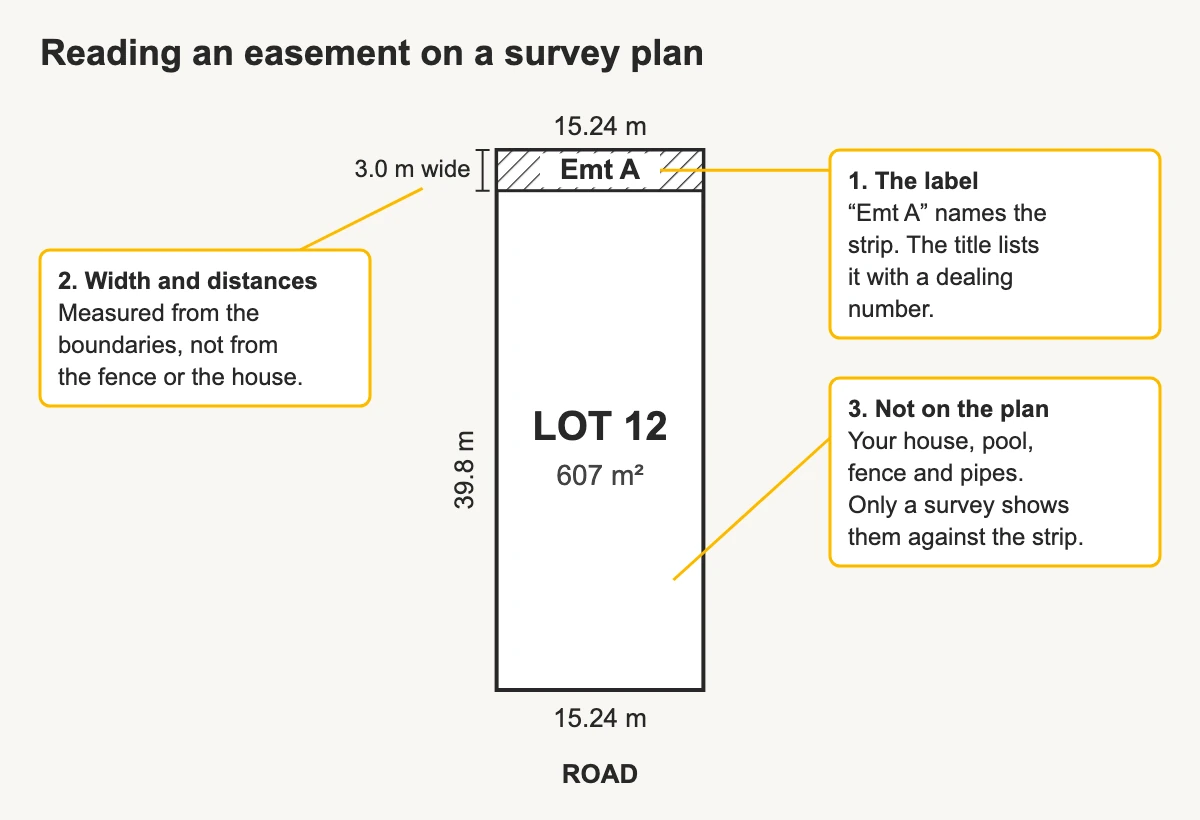
The dealing, the instrument of easement, tells you the rest. The Act requires it to state the nature of the easement, its terms, and the land benefited and burdened (section 82). Read it for three things:
- Purpose. Access, drainage, sewerage, water, electricity or another service.
- Who benefits. A neighbouring lot, or a public utility provider such as the City or an energy company. A public utility easement that is not attached to other land does not have to name a benefited lot (section 89).
- Terms. Anything it says about structures, access for maintenance, or restoring the surface after works.
If the dealing is old or hard to read, note its number and keep it with your plans. Your solicitor, certifier and surveyor will all ask for it.
What the records cannot tell you
The records tell you an easement exists and how it is described. They do not tell you where that strip falls against the pool you have drawn, the slab your builder is about to set out, or the fence line your neighbour is talking about. Plan dimensions run from the boundaries, and your fence or the Queensland Globe line is not necessarily the boundary (Business Queensland).
Pipes are a second, separate question. Most work near the City of Gold Coast's existing sewer, water supply and stormwater pipes is regulated by Queensland Development Code MP1.4, and work that meets the code's acceptable solutions but sits within a Council easement still needs the City's consent (City of Gold Coast, building work near Council pipes). The code reaches lots that contain the infrastructure or sit next to a lot or road reserve that does, not only lots with an easement (Business Queensland, build over infrastructure). The City's sewer location diagrams are useful here, but the City notes that easements over internal infrastructure may not be included on that mapping (City of Gold Coast, mapping search). So the pipe map and the easement record are two checks, and you may need both.
Where the question is what is under the ground, underground service locating is designed to map buried services before you dig. And what an easement lets the other party do, who maintains it, or whether it can be changed are legal questions for a solicitor.
Building near an easement?
Send us the address, your title search and a sketch of what you plan to build. We will give you a free quote and tell you whether an easement survey is needed and what it would show.
When an easement survey is worth it, and what you receive
If nothing is being built, dug or fenced near the strip, the title and plan are usually all you need. Once something is going near it, a survey turns the record into a position on the ground.
An easement survey shows where an existing easement falls on your property, relative to the boundaries and to what is already there: sheds, driveways, walls and retaining structures. That tells you how close a proposed pool, extension or slab would be before anyone pours concrete. Because easements are measured from the lot boundaries, an easement survey often includes identifying the boundaries where pegs are missing or the fence is doubtful. Where agreed in the scope, the easement can be marked on the ground. Otherwise it is shown on a plan your designer, certifier and solicitor can work from.
It is also the plan you need when a new easement is being created, for example for shared access or drainage in a subdivision.
We work across the Gold Coast from our Bundall office. To book, call (07) 5553 1570 or send the details through the contact form.
Your three-step easement checklist
Print this and keep it with your plans.
| Step | Where | What to note | Done |
|---|---|---|---|
| 1. Free map check | Queensland Globe, Easement parcel layer | Any strip on your lot, its label, your lot and plan number | ☐ |
| 2. Title search | Titles Queensland online search ($25.71) | Each easement listed and its dealing number | ☐ |
| 2. Plans | Survey plan image for each plan named ($27.56 each) | The strip's label, width and distances along the boundaries | ☐ |
| 3. Dealing | Image of each easement dealing ($50.16 each) | Purpose, who benefits, any terms about structures | ☐ |
| Also: pipes | City of Gold Coast mapping search | Sewer and stormwater pipes on or near the lot | ☐ |
| Next | Easement survey | Where the strip falls against your plans, on the ground | ☐ |
Frequently asked questions
Can I build over an easement on the Gold Coast?
It depends on the easement's terms and on who holds it. Inside a Council sewer, stormwater or water easement, the City's consent is needed even for work that meets the building code's acceptable solutions (City of Gold Coast). Your certifier will advise on approvals, and a survey shows how close the work would be.
Why doesn't my survey plan show the easement?
Because an easement may have been created on a different survey plan. Business Queensland says the current plan of a lot may not show easements and points to the title search instead (Business Queensland, survey plans).
Is the easement on Queensland Globe accurate enough to build to?
No. The Queensland Government says the Globe is not the point of truth for boundaries and its map lines are not the true boundaries on the ground (Business Queensland). Use it to find the easement, then rely on the plan and a survey for its position.
Does every sewer pipe sit inside an easement?
Not necessarily. Building code MP1.4 applies to lots that contain the City's pipes or sit next to a lot or road reserve that does, whether or not there is an easement (Business Queensland, build over infrastructure). The City's own sewer mapping may not show easements over internal infrastructure (City of Gold Coast, mapping search). Check the title and the pipe map.
How much does it cost to find out?
The government search fees on 10 November 2026 are $25.71 for a title search, $27.56 for each survey plan image and $50.16 for each dealing image, excluding GST (Titles Queensland). An easement survey is quoted for the site; ask us for a free quote.
Know exactly where the easement falls before you build
A free quote and advice on which survey you need, anywhere on the Gold Coast.